Why Muscle Growth Slows After 40 — And What New Sports-Nutrition Research Suggests May Help
A growing body of research suggests that the muscle-response slowdown men experience after 40 may be linked to a specific biochemical pathway. As natural sensitivity declines, the same training and nutrition that worked in your thirties produces a different result. Here is what the clinical literature shows.

If you are a man over 40 who lifts weights twice a week, eats more protein than your wife thinks is reasonable, and still looks in the mirror wondering where the muscle went — this article is going to reframe the entire problem for you.
Because the problem is not what your trainer told you. It is not what your doctor told you. And, almost certainly, it is not what the supplement aisle has been telling you for the last decade.
The problem has a name in the research literature. It is a specific signaling pathway that determines how your body responds to protein and training.
And inside your body, it works like a switch.

The Biochemical Signal That Decides Whether You Build Muscle Or Lose It
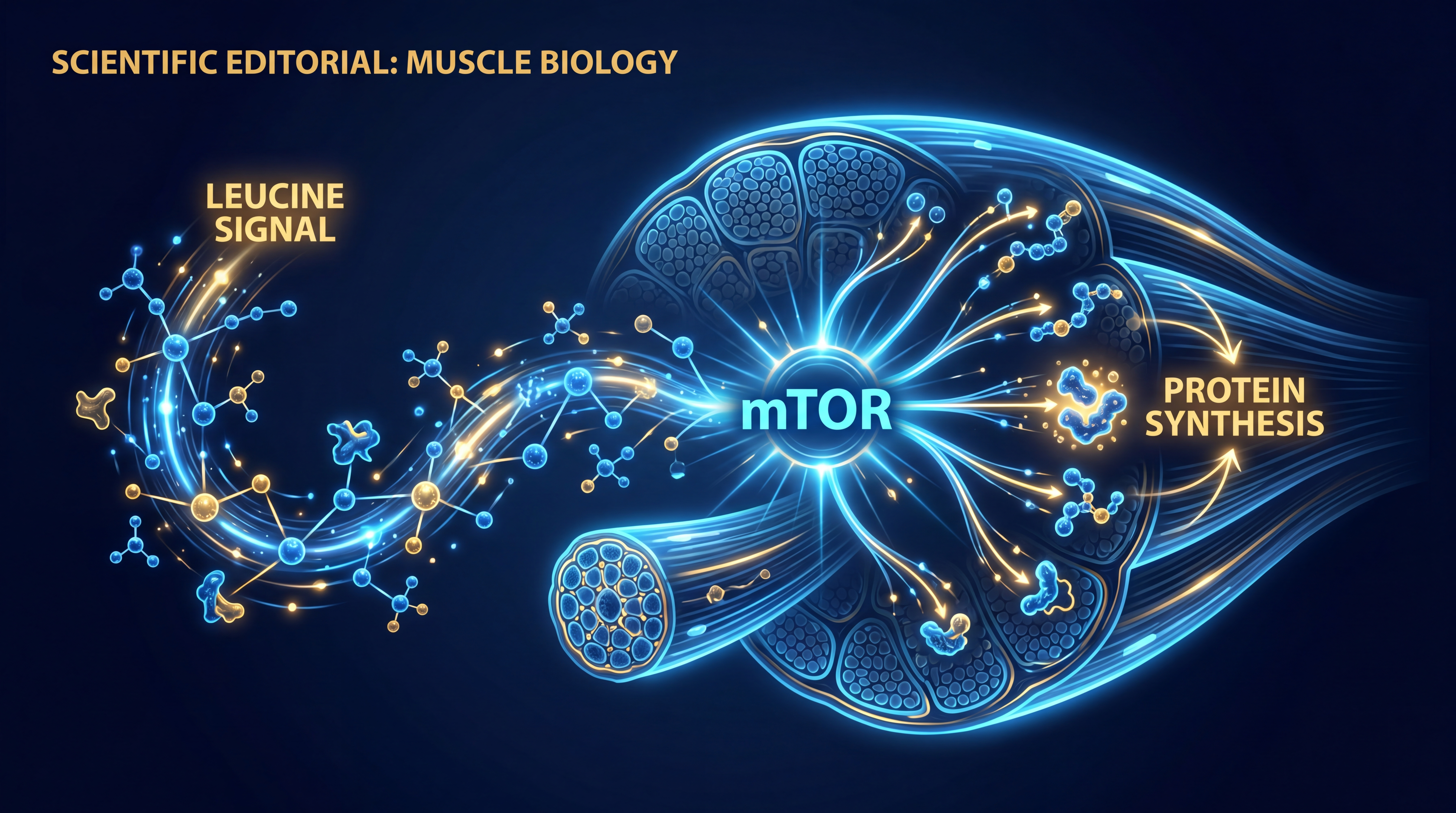
Every time you eat protein, your body makes a decision. It either turns that protein into muscle — or it doesn't. The decision is governed by a specific signaling pathway in the body. In plain English, it is the on/off signal for the natural muscle response.
When the signal is firing, the steak you ate at lunch becomes triceps. The whey shake after the gym becomes recovery. The squats become quads. Your body, mechanically, treats protein like raw material for construction.
When the signal weakens — or, more precisely, when it stops responding the way it used to — the same steak, the same shake, the same squats produce a fraction of the result. Sometimes none at all. The protein is broken down and excreted. The workout produces soreness without growth. The mirror produces frustration.
"The question researchers are now asking is not whether the muscle response declines with age — the evidence for that is fairly robust — but whether it can be meaningfully supported through targeted nutritional strategies."
This is also, incidentally, the reason most over-40 men get ambushed by the same three failures:
- You eat more protein. Nothing happens. You assume you weren't eating enough — you eat even more. Still nothing.
- You lift heavier. You get sore for 4 days instead of 2. The mirror doesn't move.
- You assume it must be hormonal. You either consider a long-term prescription route (expensive, lifelong, with side effects) or accept that "this is just what aging looks like."
None of these address the real bottleneck. They are downstream of the actual problem. The actual problem is the signal itself.
What The Research Shows: A Decade Of Work On The Aging Muscle Response
Once the connection between aging and the muscle-response slowdown became well-established in the early 2010s, sports-nutrition labs began racing for the same target: a compound, ideally a nutrient rather than a drug, that could help re-sensitize the body's natural muscle response in adults whose signal had faded.
Most attempts failed. Standard amino acids — including L-leucine, the long-time gold standard for muscle support — produced respectable but unremarkable results in older adults. The problem wasn't the signal. The problem was that the receiver had grown deaf to it.
The breakthrough, when it came, came from the next generation of amino-acid science.
A Next-Generation Amino-Acid Compound Studied In Adults Over 40
A next-generation amino-acid compound has been studied specifically for its potential to support the body's natural muscle-response signaling in muscle tissue, including in older adults. Researchers were interested in whether it could produce a stronger response than standard leucine, which has shown diminishing returns in aging populations.
In the published 10-week trial pairing the compound with normal training, researchers observed substantial increases in muscle-response markers versus baseline, alongside notably greater strength gains in the treatment group when compared to placebo on the same training program.
To put that in context: response sizes of this magnitude are relatively uncommon in nutritional research. As with any single trial, independent replication strengthens confidence in the findings, and additional studies are ongoing. The results are, however, consistent with the mechanism researchers had hypothesized from earlier amino-peptide work.
The Rest Of The Daily Routine
The next-generation amino-acid compound supports the muscle-response signal. But the full picture of the over-40 muscle slowdown has three other moving parts — daily breakdown, recovery, and the structural foundation of strength — and a serious daily formula has to address all four.
The cleanest stack we have evaluated to date pairs the next-generation amino-acid compound with three other clinically supported ingredients, each addressing a specific failure pattern of the over-40 male body:
1. Next-Generation Amino-Acid Peptide Compound
An advanced amino-acid peptide compound studied for its potential to support the body's natural muscle-response signaling. In a published 10-week clinical trial pairing the compound with normal training, researchers observed substantial increases in muscle-response markers versus baseline, with notably greater strength gains in the treatment group versus placebo on the same training program.
2. Premium-Grade Leucine Metabolite
A naturally-occurring metabolite of leucine that has been extensively studied in clinical sports nutrition for its potential to help the body protect lean muscle. Research has associated this metabolite with reductions in daily breakdown markers in adults over 40, helping the body retain the muscle it has built. It is among the more rigorously studied compounds in this category, with a meaningful body of peer-reviewed literature behind it.
3. Performance & Recovery Cofactors
The supporting cofactors in this formula are associated in the literature with recovery time and daily energy output — two areas that research suggests may be meaningfully affected by nutritional status in active men over 40. Users report variable results; individual responses differ based on training history, baseline nutrition, and overall health.
4. Strength Foundation Support
The fourth component in this formula is included for its potential role in structural strength support — legs, core, and grip function. Research on age-related muscle decline consistently identifies these functional markers as important health indicators. Population studies have found associations between reduced muscle mass and increased fall risk, particularly in men over 60.
Review the full Advanced Muscle Plus ingredient breakdown, the clinical trial details, the multi-bottle pricing, and the manufacturer's 90-day satisfaction guarantee.
See The 3 & 6 Bottle Pricing Official site · 90-day satisfaction guarantee · Free US shippingHow This Compares To What Most Men Over 40 Are Already Trying
For context, here is how this daily routine compares against the most common alternatives men in this age group typically reach for first, across the dimensions that matter for the over-40 muscle response:
| Approach | Built For Over-40 Response? | Protects Lean Mass? | Multi-Benefit (Energy, Recovery)? | Real Cost / Month |
|---|---|---|---|---|
| Whey protein only | ·· partial signal | ✕ | ✕ | $30–$60 |
| Creatine monohydrate | ✕ | ✕ (different mechanism) | ✕ | $15–$30 |
| BCAA powders | ✕ | ✕ | ✕ | $25–$45 |
| Pre-workout stimulants | ✕ | ✕ | ·· energy only | $25–$50 |
| Generic "muscle builder" pills | ✕ (no clinical research) | ✕ | ✕ | $25–$50 |
| Advanced Muscle Plus | ✓ direct | ✓ | ✓ | ~$66–$72/bottle · 90-day refund |
Read down that "Built For Over-40 Response" column. Almost nothing on the men's-strength shelf actually addresses the natural slowdown. Whey, the most common approach by miles, only partially supports the signal — and produces a steadily weaker response in adults over 40.
Which is the entire reason most men in their forties feel like the same protein powder they used to live on quietly stopped working.

User-Reported Outcomes: What Men Describe After 4–8 Weeks Of Use
"The last time I saw gains like this, I was in high school."
— Paul M., featured on the manufacturer's site
Individual results vary, and testimonials are not a substitute for clinical evidence. That said, the user feedback we reviewed was largely consistent with the mechanisms described above. Among men reporting results in the first 4–8 weeks of consistent use:
- Visible firming in arms and shoulders — the first place visible muscle change tends to show in over-40 men.
- Recovery time on hard workouts dropping from 3–4 days back down to 1–2.
- More daily energy and stamina — less of the mid-afternoon flatness that quietly defines life after 40.
- Grip strength noticeably returning — a small thing that translates into a long list of larger ones.
- Posture quietly straightening — the thoracic-spine collapse most men don't notice until someone mentions it.
- Sharper focus, drive and confidence — the small mental shift that comes back when you start looking in the mirror and recognizing yourself again.
- A general sense, hard to put a number on, of having one's body back.
None of this is a "transform your physique in 30 days" claim. What men describe is, almost universally, the return of a feeling: that the work is finally producing the result it should have been producing all along.
Who This Is Built For (And Who It Isn't)
Plain answer: Advanced Muscle Plus is built for the man over 35 — ideally over 40 — who is still putting in the work and is no longer getting paid for it. Specifically:
- Men whose lifts have plateaued or quietly slid backward in the last 2–5 years.
- Men who eat enough protein and still see no visible muscle gain.
- Men whose recovery time from training sessions has noticeably lengthened since their thirties.
- Men who would rather solve this nutritionally than start a long-term prescription route they cannot easily exit.
- Men over 50 who are starting to feel the small tells — weaker grip, slower up-the-stairs, "old guy" posture — and want to head it off now, while the response still comes back quickly.
It is probably not for: men under 30 (your natural response is still firing fine), men who don't lift or move regularly (no signal for the response to support), or men looking for a 7-day transformation (this is a 6–12 week story, not a one-week story).
The Pricing — And Why Most Men Order Multiple Bottles
The formula is sold direct from the manufacturer in three options. Here is how the math works:
Why most men order the 3 or 6 bottle pack: this is a 6–12 week response, not a 7-day one. A single bottle is roughly a 30-day supply. The vast majority of men who try the formula and stay with it report their visible changes between weeks 4 and 10 — which is exactly the window the multi-bottle packs cover, while removing the friction of re-ordering and shipping.
The 6-bottle option saves nearly $200 versus single-bottle pricing, ships free, and is fully covered by the 90-day satisfaction guarantee — meaning you can evaluate it against your own body, with very little risk.
Editorial Assessment: What The Research Adds Up To
The newer sports-nutrition research adds an important dimension to a conversation that has long centered on either protein intake or acceptance of age-related decline. The clinical literature suggests the issue may be more nuanced: not a loss of capacity, but a reduction in the signaling sensitivity that determines what the body does with the protein and training stimulus it receives.
The next-generation amino-acid peptide compound studied here appears, in the available research, to support that natural signaling. The premium-grade leucine metabolite has a meaningful evidence base for helping the body protect lean muscle. Taken together, the formula represents one of the more research-grounded daily routines we have evaluated in this category. As with any supplement, results vary and nothing here constitutes medical advice.
The formula is backed by a 90-day satisfaction guarantee, which meaningfully lowers the barrier to evaluating it against your individual response. Men's Body Wire is not affiliated with the manufacturer's refund process; terms and conditions apply and are available on the manufacturer's site.
Most men start with the 3-bottle pack. The 6-bottle pack saves the most and includes free US shipping. Both are covered by the 90-day satisfaction guarantee.
See The 3 & 6 Bottle Pricing Official site · 90-day satisfaction guarantee · Free US shippingYou will be taken to the official Advanced Bionutritionals page to complete your order.
Editorial Policy: Articles on Men's Body Wire are researched and written by our editorial staff. Where relevant, we note the clinical sources behind claims, and we distinguish between findings from peer-reviewed studies and user-reported outcomes. We do not accept payment for editorial coverage. View our editorial policy →
Health & Medical Disclaimer: This article is for informational and educational purposes only. It does not constitute medical advice. Statements regarding dietary supplements have not been evaluated by the Food and Drug Administration. Products discussed are not intended to diagnose, treat, cure, or prevent any disease. Individual results vary. If you are taking prescription medication, have a pre-existing medical condition, or are over 65, consult a qualified healthcare provider before starting any new supplement or training program. Full medical disclaimer →
References: 1) Drummond MJ et al. "Skeletal muscle protein anabolic response and mTORC1 signaling," Journal of Applied Physiology, 2008 — PubMed. 2) Volpi E et al. "The response of muscle protein anabolism," J Clin Endocrinol Metab, 2000. 3) Wilson GJ et al. "Beta-hydroxy-beta-methylbutyrate," Br J Nutr, 2014. 4) Luo et al. "mTOR and AMPK Signaling in Skeletal Muscle Hypertrophy," Frontiers in Medicine, 2025 — PMC. 5) Harris S et al. "Protein and Aging: Practicalities and Practice," Nutrients, 2025 — PMC. 6) Tarp et al. "Grip Strength and All-Cause Mortality," Tromsø Study, 2017 — PMC. All product trademarks belong to their respective owners. Men's Body Wire is not affiliated with Advanced Bionutritionals.